Friday, 27 May 2011

Translation of the Lord's Prayer from an Early Coptic Manuscript

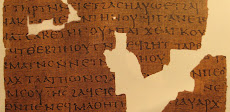
I have just submitted my PhD thesis. The thesis dealt with an early (4th century?) Coptic manuscript. Here is a literal translation of the Lord's Prayer from the manuscript. Note that the long form of the Lord's Prayer (for thine is the kingdom, glory, and power) developed later as a befitting conclusion to the prayer and was not a part of the original text of Matthew's Gospel.


As for you, therefore, it is in this way that you should ask:

Our Father in heaven, may your name be hallowed. May your kingdom come to us. That which you will, may it be; as it is in heaven, may it be done upon the earth. Give us our bread of tomorrow today. Forgive our debts in the way that we, for our part, are forgiving the ones indebted to us. Do not bring us into temptation, but deliver us [lit., you certainly shall deliver us] from evil.

Monday, 8 December 2008

Marty Foord on Theology of Canon

My good friend, scholar, and all around good guy Martin Foord of Trinity Theological College, Perth Australia (http://www.ttc.wa.edu.au/faculty.shtml) shared some thoughts and interacted with us Tyndale House Text and Canon members on the theology of Canon today.

The issue is how do we know which books should be in the Bible. Marty set the discussion in the context of polemics with Roman Catholics and those of the Orthodox faith who claim a different set of books than Protestants, and for different reasons. This is an important and difficult question. One of our members is from a Greek Orthodox tradition and is constantly having to defend herself against traditionalist in her country who perhaps even accuse her of being a heretic for denying Apocryphal books such as 1 and 2 Maccabees or Judith, etc. Thus, one must ask, How does a person properly argue for the 66 books?

Marty’s basic method in answering the question is to ask, “What does the Bible say about itself?” Sure, 2 Tim 3:16 says that the Bible is inspired, etc., but nowhere does the Bible say that these 39 Old Testament books are in, and these 27 New Testament books are in, but the others are out. However, Marty argues that the Bible does say some things about what books are authoritative and which are out.

Marty’s primary text is John 17 which speaks of Jesus sending the 12 into the world, and having been taught his word. This is bolstered by such passages as Eph 2:20 which refers to God’s household being built on a foundation laid by the apostles, and the passages in the Pauline letters which refer to Paul’s associates as his fellow apostles who co-author the letters.

This is strongly connected to the notion of apostolicity as the basis for what books should be in the canon. If an apostle wrote the book, Marty argued, it should be included in the canon since Jesus says that he has sent the apostles and given them his Word.

Marty seems to reject a closed-canon concept. He says that every generation should reconsider which books are in the canon. He suggested that should a lost letter of an apostle be found, we should, by all means, add it to the Bible, bringing us 67 books.

One of the tests of apostolicity of a book pending consideration is how well it fits with the other apostolic books. If it doesn’t fit what the apostles otherwise say, then it must not have been written by an apostle.

In regard to the Old Testament, Marty argued that since we don’t know the history of the development of the Old Testament Canon, then we should be content to accept the 39 books. When pressed if we should accept the 39 Old Testament books (and not the expanded list of the Catholics and Orthodox), Marty suggested that we must not follow the leading of the Judaism of late antiquity; Jesus condemned those religious leaders for their every evil word. Instead, we must accept the Old Testament which the apostles used.

There were many loose ends, and a number of questions seem obvious. First, I’m not entirely certain that John 17 has much to say about apostolicity. Second, we can only say that the author of Hebrews might have been closely associated with Timothy—but perhaps there is reason to think that Timothy may have lacked certain aspects of apostolic authority; and so we can only conclude that the author of Hebrews was a friend of someone who might have been an apostle. Third, I’m not sure that everything that every apostle ever said or wrote was inspired; maybe the lost Corinthian letter was not divinely preserved simply because God did not inspire it. Fourth, the criteria that an apostle’s writing must not conflict with other apostolic books ends up being circular; plus, what about all the “contradictions” in the Synoptic accounts—perhaps Luke should be out of the canon on the basis that the torn veil is a pre-mortem event while in Matt and Mark it is a post-mortem event? Fifth, the apostolic writings don’t confirm all 39 of the Old Testament books; for example, Esther and Ecclesiastes would be out.

Much more could be said. I’m not sure how all this works out. I am pretty happy with Marty’s assertion that canon is closely connected with apostolicity. I do, however, like the concept that over the first several centuries the church was led by the Spirit into a consensus of which books should be included. Unfortunately, this does make the Old Testament a bit trickier since the Apostles seemed to like the Septuagint text better than the Hebrew text, and by implication, would include the books of the Apocrypha.

Ultimately, we’re still struggling to work all this out. I don’t think we have any pat answers here. But Marty’s connection of canon to apostolicity is important, and he provided us with considerable stimulation. I look forward to future discussions.

Inerrancy, "Contradictions," and God's Perfect Text

My prior blog on inerrancy prompted a question regarding the two accounts of Jairus' daughter. Mark 5:23 has Jairus saying that his daughter was near death, whereas Matt 9:18 has him saying that she was dead. How then can the text be inerrant in the face of such blatant contradiction.

There are so many "contradictions" of this sort in the Gospels. My favourite is the ripping of the veil. In Matthew and Mark, it comes consequent to Jesus' death, while in Luke, it precipitates Jesus' death. In such cases, we moderns are prone to impose our concept of exactitude onto the text, as if the disciples set themselves staged on the two scenes with atomic clocks awaiting to see whether the veil ripped first or Jesus' death occurred first, with wireless walkie talkies to communicate the results.

But I think inerrancy allows for such inexactitudes. If you ask me what time it is, I respond, 8:15, when in fact it might be 8:17:04.

The case of Jairus' statement is a little different. Is Matthew allowed to telescope past Mark's detail of the process of Jairus first saying that his daughter was sick and then consequently being informed of her death? I think so. If I were telling the story and wanted to pare it down to its essentials while maintaining good literary form, would I be allowed to change Jairus' words in order to get to the main point that she was dead? I think so--at least by ancient standards. I think if you asked a first century Jew if Matthew or Mark were mistaken in their reports, I think they would say "No."

In the case of the disparities in the ripping of the veil, Matt and Mark's presentation emphasises a theology of judgment: Israel just killed God's Son, and judgment and destruction is consequently inevitable. In contrast, Luke's presentation emphasises the vindication of Jesus: Jesus cried, "Into your hands, I commit my spirit," and God opens the veil in order to welcome him into the heavenly Holy of Holies.

I'm not sure if there are any theological motivations behind Matt's presentation of the Jairus' story. He may have modified it for literary reasons. Matt constantly reduces Mark's story down to the essentials for literary effect. The process will inevitably produce the kinds of inconcinnities as we find in this pericope.

Ultimately, we must ask, "Is the text exactly the way that God wanted it to be?" By faith, I reply, "Yes."

Friday, 5 December 2008

Bart Ehrman and the Grace of Agnosticism

Having made the assertion in a previous blog that text critics are the nicest people in the world, I’m sorry to say that I’ve seen a couple of glaring exceptions, both involving panel book reviews at Society of Biblical Literature, and both involving Bart Ehrman.

The first exception was at SBL a couple of years ago. Larry Hurtado’s excellent volume on biblical manuscripts as the earliest artefacts of Christianity was presented for review by Prof. Ehrman and three others (Kim Eitzen-Haines and Anne-Marie Vanl.) Prof. Ehrman was perhaps more than forthright. Off the top of my head, I seem to recall that among the issues of contention was Prof. Hurtado’s presentation of evidence for the preferential status of writings which would later receive canonical status, as contrasted with writings which would later be deemed heretical. The vigorous exchange between the two good professors culminated in Ehrman’s explicit accusation that Hurtado was prejudiced by his prior theological commitments to historic Christianity, evoking Hurtado’s telling response that he was not the only panel member with prior theological commitments. This withheld statement screamed loudly the news that Ehrman’s recent publication, Misquoting Jesus was a shameless apologetic against historic Christianity, and precipitated Ehrman’s newest (2008) anti-apologetic work about how the Bible cannot explain the problem of pain.

I witnessed the second exception just last week at the annual SBL meeting in Boston. Again, the context was a panel review, this time of David Parker’s latest work on textual criticism Title. The panel featured perhaps five of the most recognised names in textual criticism: Eldon Epp, Ehrman, Hurtado, and Michael Holmes, and of course Prof. Parker. In this session, Prof. Ehrman was vitriolic and struck me as ungracious, if not outright vicious.

Before proceeding to Ehrman’s review, I should say something about Prof. Epp’s contribution. He briefly described the book, and then quickly moved to a point of contention he has with Prof. Parker. Prof. Parker seems entirely pleased to get beyond text types, but Prof. Epp doesn’t share such a dismissive perspective. He gave an excellent defence of text types, which he describes as being more like textual constellations. We look forward to reading his discussion of the topic in the coming year. Prof. Hurtado also reinforced Epp’s discussion.

After Prof. Epp’s paper, Prof. Ehrman proceeded to heap the highest praise on Prof. Parker, followed by what struck me as a concerted effort to be as insulting as possible. The primary point of substantial criticism was that the book fails to be an introductory text to our discipline, contrary to its subtitle. One gets the impression that if Prof. Parker had omitted the subtitle, Ehrman’s presentation would have been reduced down from 20 minutes to three or four. One or two others mentioned the same thing to me in private, but I found it interesting that instead of conceding the point, Prof. Parker took time in his response to embrace the notion that his book is indeed an introduction.

I should note that if the book is indeed to be read as an introduction, then Ehrman’s criticisms struck me as having the sound of truth in them. In this regard, I found Ehrman’s vitriol curious. At first, his comments seemed witty and good natured, evoking a number of chuckles throughout the large audience. However, after a string of such comments, their more sinister nature seemed in evidence. They seemed designed to ridicule and humiliate, and eventually, many in the audience realised that chuckling to these sorts of cheap shots was unbecoming of academia. Ehrman’s nasty as possible approach to critiquing this work was unnecessary. He could have graciously pointed to the weakness of referring to this volume as an “introduction” without trying to ridicule Parker as dithering and inept. Indeed, one or two of the other panellists mentioned the same criticism, but did so with respect and appreciation for Prof. Parker.

A good example of a stinging and crippling review with class and respect is Gordon Fee’s review of Ehrman’s Orthodox Corruption. In this short review, Prof. Fee’s criticism of Ehrman’s work is entirely devastating. However, the destructiveness of Prof. Fee’s criticism is actually rather subtle; one needs to read it carefully to see its power. Most importantly, Fee seems pained to write such a devastating critique. His criticisms are not the sort which are “in your face.” One need not be insulting when critiquing another person’s research.

I was impressed with Prof. Parker’s gracious response toward Prof. Ehrman. I would have been tempted to ignore Ehrman’s critique in its entirety, and spent my time engaging with the other three panellists.

It seems that Prof. Ehrman is destined to continue to sit on future review panels in textual criticism sessions at SBL, simply because he draws a crowd. This may indeed be rather unfortunate. I was told by someone that at least one significant text critic with close professional ties to Prof. Ehrman was quite embarrassed by his performance. Rightly so, and for this reason, one would hope that future reviews will be more disciplined.

One scholar asked if such ungraciousness is simply typical of someone who has made a major paradigm shift from Evangelicalism to agnosticism. The question may be enlightening.

Thursday, 27 November 2008

The Rhetoric of Inerrancy

Some Evangelicals go out of their way to combat the term inerrancy. As I've said recently, I don't mind Evangelicals not using the term inerrancy, but I think it is problematic for Evangelicals to make the concerted effort to berate the usage of the term.

Usually, Evangelicals who berate the term inerrancy are quick to affirm the Bible as the Word of God. They might even affirm the Bible's "infallibility" (I can't really perceive much difference between the two terms) and "authoritative."

This being the case, their argument against "inerrancy" is problematic. They end up implying that the Bible has errors in it, and this is a problem for people who otherwise have such a high view of scripture.

SBL and Fellowship of the Guild

I attended the annual meeting of the Society of Biblical Literature last week in Boston, and hope to make a few blog posts about it. This post contains some general comments about my experience of the guild.

Last year, SBL was at San Diego. One text critic who is not an American made a general comment last year about how militarised America is. Of course, he was generalising based upon his experience of San Diego which is a significant centre of military activity in the U.S. This year in Boston, I didn’t see a single military person in uniform. I suppose it is possible that Boston has largely been demilitarised since the days when its harbour was clogged with British warships and citizens were required to provide room and board for Redcoat soldiers.

One thing I’ve learned in the last several years is how gracious text critics are toward each other. There seems to be a genuine camaraderie and eagerness to fellowship with one another. I’ve especially been impressed with how accepting they’ve been of me as a very junior member of the guild. A number of senior members of our discipline have taken a genuine interest in my work and have said or written encouraging things to me. One senior member entrusted me with a paper he presented for the meeting, although he intends to publish it soon, just cautioning me about how I might cite it prior to its publication. Other significant members have seen my blog and gone out of the way to say nice things about it. Another member initiated a conversation with me on a particular issue and was very helpful in pointing out a basic misunderstanding I had of another text critic’s work.

One of my best experiences was on my first day of my first SBL annual meeting in Philadelphia in 2005. I had been out of academia for a dozen years or more and had been completely out of touch with my former associates at Regent College, and so I hardly knew anyone at the meeting. I sat down at a general orientation session coincidentally near a distinguished gentleman who kindly introduced himself to me, and we quickly discovered our mutual interest in text criticism . As it turns out, this was none other than James A. Royse whose chapter on scribal habits in the Holmes-Ehrman volume I had read before, but had forgotten his name. His gracious demeanour toward me is something I won’t ever forget.

Along these lines, I have to mention how text critic Amy Anderson encouraged me during this time. Amy teaches at North Central College in Minnesota and published an important work on a group of manuscripts known as family one. I read this work back in 2005 and zipped off a brief email to her thanking her for such a good quality work. At the time, I was in an interim pastoral ministry and was unsure of my next career move. She promptly replied and helped me see an avenue toward working on a PhD. An important element, she explained, was to attend SBL and to get to know some people. I checked into it, but the cost for non-students was so prohibitive that I simply could not afford to go, especially since I had just had a job change and was financially insecure.

Amy, however, was persistent. About a month before the meeting, she initiated another email exchange, urging that I attend SBL. She talked me into it, and this was one of the best decisions I’ve made. More than that, Amy drew me into her group of students and associates so that I was not a loner at the conference. She even included me in a lunch meeting with David Parker. I hope that I can honour her by having the same encouraging and generous spirit toward others in the years to come.

Since that time, I’ve been privileged to get to know most of the text critics who blog at Evangelical Textual Criticism. This is a special treat and has afforded me many opportunities for serious informal discussion of our guild. They are all very generous and tolerant of me even whenever I spout out stuff about which I know nothing (which is often). I always walk away better informed and feeling like I have an inside track on issues in the discipline.

Wednesday, 26 November 2008

Inerrancy, Authority and the Original Text

I had a good chat with a long time scholar friend who bristled at the term inerrancy. He does believe in the authority of the Bible, but argued that we should avoid the term inerrancy since we don't have the original manuscripts of the Bible.

But nonetheless, the Bible is authoritative, he assured me.

The problem with this line of argumentation is that it fails to understand that the text is something which is non-physical. The Word of God is "immaterial" and is merely reflected (more or less) in the various manuscripts of the New Testament, depending on the accuracy of the scribe and exemplars. We reconstruct the inerrant Word of God as best we can based upon these material witnesses. The physical manifestation of the text (i.e., the manuscripts) are patently not inerrant--they have errors in them; yet the ultimate reality of God's Word behind the physical manuscripts is perfect.

My friend would not accept this argument of mine, insisting that it is impractical to argue for the perfection of something which has no physicality. So I asked him what is it then that he thinks is "authoritative." He replied, "The Word of God." But I replied, "Do you mean the physical manuscripts, or the real text behind the physical manifestation of the text reflected in the manuscripts?"

This stumped him. Ultimately, if you can't have an inerrant text without the original manuscripts, neither can you have an authoritative text without the original manuscripts.

Of course, for myself, I have no problems with saying that the real text behind that which is physically manifested in the manuscripts is inerrant, and the fact that we don't have the original manuscripts doesn't impact this perception.